The Amplified Seam
Most sensitive LPI test possible with Th-229 amplification — extending a twenty-year clock-comparison lineage, not inventing it.
The undersold prize — amplified K
Th-229’s isomer near-cancellation yields huge K versus sector-dependent couplings. That is the seam V3 reached for with the wrong floor and the wrong “first” claim.
Even at today’s published-class Th instability (~3×10⁻¹²/√τ; approaching ~10−15 over a day — verify vs PTB public abstract when citing), a year of white-noise averaging points toward κ near 10−10–10−11 versus existing ~10−7-class limits — an honest stronger claim than V3’s wrong-floor 10−8 story.
Free annual signal
ΔU/c² ≈ 3.3×10⁻¹⁰ — the annual solar gravitational potential modulation — is free. Phase-quadrature (cos + sin against the orbital cycle) separates true annual coupling from slow drift. Keep the V2 Poisson post-mortem spirit: honest arithmetic that kills bad methods.
Bound on κ vs integration time
Three Th scenarios: today’s ~3×10⁻¹²/√τ · projected 10−17 · theoretical 10−19. Amplification means today’s curve can overtake ~10−7-class limits quickly; the deeper prize is pushing toward 10−10–10−11 with year-scale averaging.
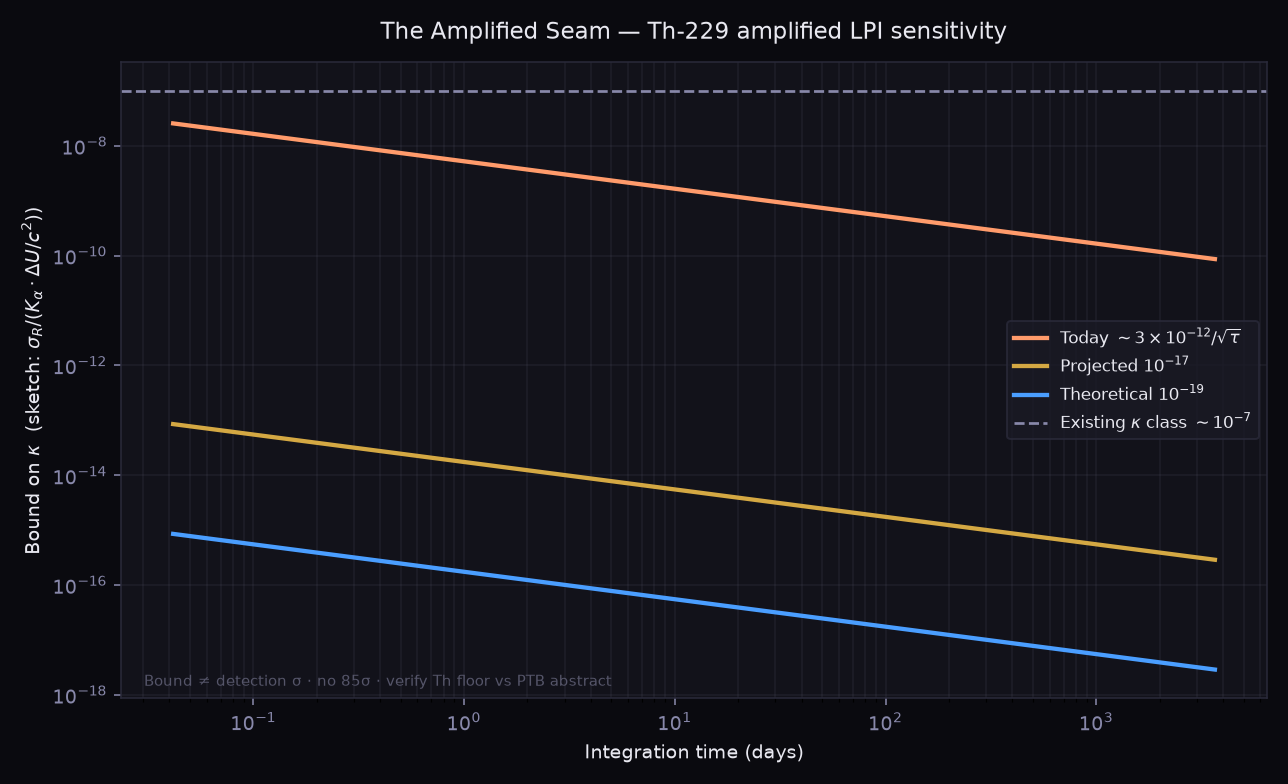
Figure — The Amplified Seam contribution. Generated by chronal_amplified_seam_v4.py. Bound ≠ detection significance. No 85σ. Th floor labeled for verification against PTB public abstract.
Systematics
- Annual lab temperature as a twin nuisance — fit temperature as a regressor, do not ignore it.
- Th:CaF2 ~0.4 kHz/K on some lines — use zero-shift-point operation and a co-thermometer line to suppress thermal uncertainty.
- Lunar-tidal cross-check — shorter period template; keep as consistency test.
Three Rivers (named properly)
A two-clock ratio degenerates electromagnetic (α) vs quark-mass / ΛQCD couplings. Add a third species — Yb⁺ E3 (K≈−6) or Cs hyperfine — and three ratios can map both couplings. Chronal V4 must pan out toward that map; this page does not claim Three Rivers solved.
Practical move
PTB-led Th-229 work (June-era lineage): 148 nm subharmonic continuously compared to Yb⁺ — nuclear-vs-electronic ratio already being recorded. Frame V4 as an analysis proposal for such streams, with open code in this repository. Prefer that over asking the world to build a new lab.
Lange et al. 2021 quadrature validation: fail-closed stub in the script until a public ratio series is wired — not yet reproduced beats fake success.
Key references (ancestors)
[2] Fortier et al. — Hg⁺ / Cs optical–microwave comparisons.
[3] Guéna et al. 2012 — Rb / Cs.
[4] Lange et al. 2021 — Yb⁺ / Sr / Cs improved limits.
[5] Damour & Donoghue — dilaton couplings to matter (theory language for sector dependence).
[6] Zhang et al. 2024 — Th-229 / Sr frequency ratio (prior nuclear–electronic ratio; not “first invented here”).
[7] PTB / JILA / TU Wien Th-229 nuclear-clock demonstration and ongoing optical comparisons — verify instability numbers against public abstracts when citing.
[8] Prior FreeLattice layers: V3 · V3 report · V4 report.